The Mid-Set Reset Arc
Intentionally clearing auditory fatigue halfway through an extended performance to pivot genre, recalibrate room attention, and construct a secondary, higher peak.
- Ideal Slot: Mid-to-Late Transition
- Harmonic Step: Modulation / ±1 Semitone
- BPM Window: 122 → 118 → 128 BPM
- Tension Index: Moderate / Recalibrated
The Physics of Auditory Cleansing
Continuous peak energy desensitizes dancefloors. The Mid-Set Reset functions as an intentional acoustic purge.
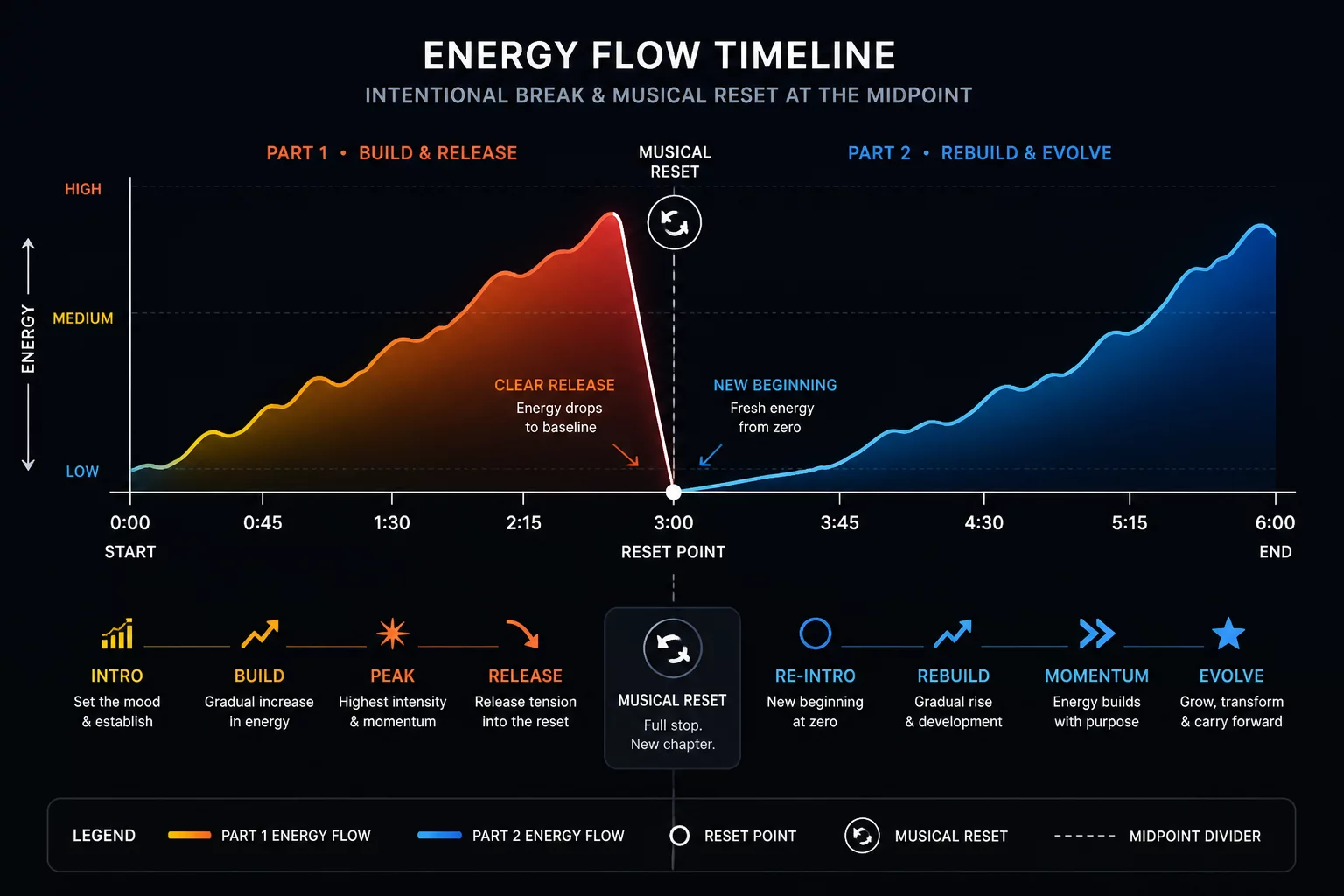
Dancefloors experience sensory saturation after approximately 45 to 60 minutes of sustained high-pressure kick drums and dense frequency content. When the acoustic ceiling remains constant, subsequent climax tracks lose emotional impact. The Mid-Set Reset introduces a deliberate decompression valley—stripping away percussion, widening harmonic space, and letting the room breathe before initiating a completely new trajectory.
Executing this reset demands composure. By dropping tempo by 4 to 6 BPM or shifting from peak-time driving techno into atmospheric dub, broken beat, or ambient chord washes, the DJ reclaims narrative control. Rather than clearing the floor, this calculated valley resets collective auditory sensitivity, priming dancers for an explosive secondary escalation.
"A reset is not a loss of momentum; it is the tactical withdrawal that makes the final charge undeniable."
Progression Metrics & Energy Dynamics
Step-by-step telemetry for stripping energy, sustaining the reset bridge, and re-engaging the room.
| Parameter Phase | Energy Level | Transition Mode | Recommended Track Type |
|---|---|---|---|
| Phase 1: Peak Deconstruction | 85% → 50% | Long Filter Tail / Reverb Decay | Extended breakdown, stripped groove |
| Phase 2: Atmospheric Zero-Point | 25% → 35% | Seamless harmonic pad mix | Ambient wash, beatless synth, spoken vocal |
| Phase 3: The Seed Groove | 45% → 65% | Tight 16-bar syncopated cue | Raw percussion, sub-heavy broken beat |
| Phase 4: Secondary Ascent | 70% → 95% | High-energy EQ swap & riser | Driving peak-hour anthem or tech cut |
The Zero-Point duration should rarely exceed 60 to 90 seconds in club environments. In festival or extended marathon settings, this decompression zone can safely stretch to 3 minutes without losing crowd commitment.
Technical Deployment & Harmonic Transition
Detailed technical mechanics for executing the reset without inducing dancefloor panic.
Disengaging low-frequency drive via a high-pass filter coupled with 1/2-beat ping-pong delay and 4-bar reverb decay, leaving only airy harmonic pads on channel one.
- Freeze the reverb tail just as the incoming ambient track introduces a low drone.
- Drop channel one fader completely during the ambient drone's third bar to avoid harmonic dissonance.
Shifting down from 128 BPM to 118 BPM utilizing triplet subdivisions or half-time breakdowns to disguise tempo alterations.
- Align the incoming down-tempo track at exactly half-time phrase marks for natural rhythmic coherence.
- Re-engage pitch faders smoothly over the next two tracks to progressively regain kinetic momentum.
Deploying an unexpected recognizable vocal stem, field recording, or broken-beat percussive track that completely changes sonic context.
- Select a key-compatible track that contrasts sharply in instrumentation (e.g., analog synth vs digital FM bass).
- Maintain continuous sub-bass presence if the dancefloor is packed, preventing visual room exodus.
Complementary Arc Structures
Explore adjacent narrative blueprints for diverse room energies and set durations.
Set Arc Discussion
Observations, floor reactions, and acoustic calibration feedback from active DJs in the field.
No comments yet. Be the first to leave a field observation.