Conducting Post-Set Notes
Systematic post-performance logging turns unpredictable dancefloor variables into repeatable structural insights.
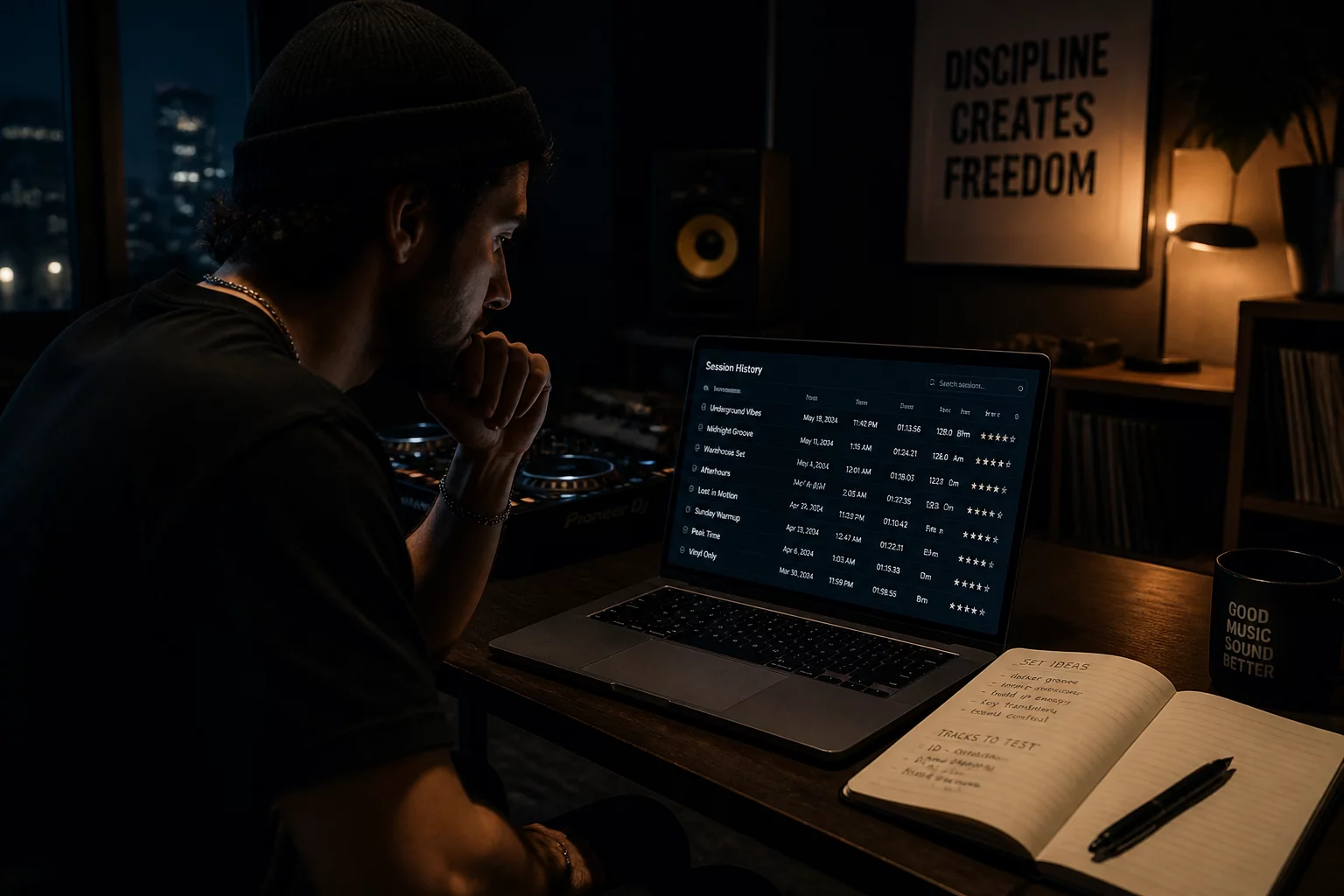
Audit Protocol Matrix
- Recommended Logging Window
- Within 2–4 Hours
- Core Metrics Tracked
- Energy, Blends, Crate Deviations
- Primary Audio Artifact
- Master Out WAV File
- Data Sync Method
- History CSV & Waveform Cue Timestamps
- Review Cadence
- Weekly Architectural Audit
Six Structural Checkpoints for Session Analysis
Energy Curve Alignment
Cross-referencing planned room energy trajectories against actual crowd response at discrete 15-minute operational blocks.
Transition Stability Audit
Identifying phase collisions, low-end EQ masking, and key clashes that weakened kinetic momentum during extended blends.
Crate Deviation Mapping
Documenting unplanned selections, rescue transitions, and sudden genre detours triggered by shifting room dynamics.
Floor Retention & Dropouts
Pinpointing specific breakdown structures or prolonged rhythmic tension points that prompted bar migrations or floor attrition.
Gain Stage & Level Discipline
Auditing master headroom preservation, booth acoustic monitor balance, and limiting artifacts recorded on the master track.
Crate Utility Scoring
Flagging redundant unplayed files and tagging unexpected hero records that yielded outsized emotional resonance.
Transforming Live Session Logs Into Structural Intelligence
Every live set represents an intense, real-time negotiation between architectural preparation and spontaneous room variables. Leaving the booth without documenting immediate acoustic realities allows vital tactical discoveries to evaporate into vague recollections.
Systematic post-set analysis bridges the gap between how a performance felt in the booth and how it translates on tape. By pairing exported session history logs with raw master audio recordings, you can objectively isolate transition friction points, verify harmonic combinations that produced unexpected emotional lift, and evaluate whether your mid-set tension arcs unfolded at the correct pace.
The 4-Hour Auditing Window
Document qualitative observations before sensory memory fades. Recording crowd reaction nuances, monitor acoustic issues, and booth ergonomics within four hours preserves granular data that 48 hours of distance inevitably obscures.
Comprehensive documentation extends beyond track selection into environmental variables: room thermal density, speaker horn dispersion characteristics, monitor delay latency, and crowd ingress pacing. Recording these physical venue conditions over consecutive performances creates an authoritative reference bank, ensuring your next crate build accounts for real-world acoustic parameters.
- Tag exported tracklists with precise crowd engagement scores and notable harmonic pairing discoveries.
- Annotate master audio waveforms at exact timestamps where energy dips or frequency masking occurred.
- Archive documented recovery maneuvers to build an intuitive catalog of tested tonal and tempo reset solutions.
Calibrate Your Performance Framework
Connect with our technical desk or explore complete set arc templates to reinforce your harmonic and dynamic workflows.
Architect Commentary
No architect commentary recorded yet. Be the first to leave a field note.
Leave Architecture Note