The Gradual Build Arc
A patient, highly disciplined structural strategy that systematically layers rhythmic density, harmonic momentum, and frequency width to elevate the room without premature peaks.
- Ideal Slot: Warm-Up to Peak Bridge (23:30–02:00)
- Harmonic Step: Camelot ±1 / Relative Minor-to-Major Shifts
- BPM Window: +6 to +10 BPM across duration
- Tension Index: Controlled Incremental (7.8 / 10)
Foundations of Incremental Pacing
Why gradual ascension locks a dancefloor into prolonged focus without exhausting crowd stamina.
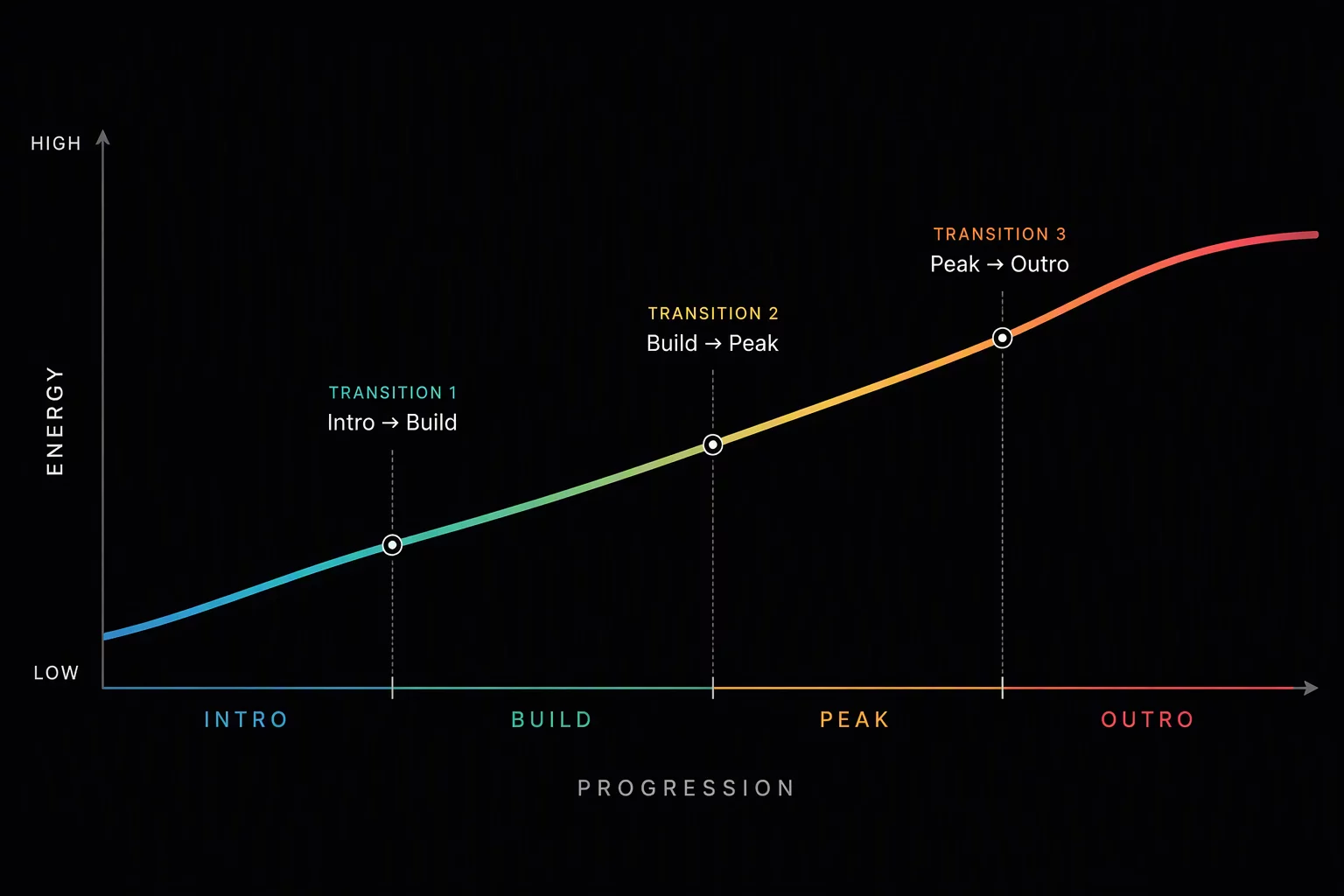
The Gradual Build Arc relies on incremental pressure rather than sudden theatrical surges. By introducing minor percussive variations, subtle bassline harmonics, and slowly broadening acoustic frequencies across consecutive tracks, the selector establishes a consistent forward momentum. Every transition functions as a stepping stone rather than a dramatic rupture.
When executing this structure across a two-to-three-hour window, the DJ preserves headroom both sonically and emotionally. Instead of dropping high-impact anthems early, each selection slightly raises rhythmic density or adds vocal elements that prepare listeners for intense peak-hour frequencies later in the performance timeline.
"True momentum is not created by throwing the biggest track into the mix; it emerges when every successive bar makes the previous record feel like an essential foundation."
Phase Distribution & Transition Parameters
Systematic phase targets for maintaining structural integrity from ground floor to peak intensity.
| Parameter Phase | Energy Level | Transition Mode | Recommended Track Type |
|---|---|---|---|
| Phase 1: Groundwork Anchor | 35% - 50% | Long 64-Bar Blends (Low EQ swap) | Deep Hypnotic Grooves & Stripped Drums |
| Phase 2: Harmonic Escalation | 50% - 68% | Mid-Frequency Weaves & High-Pass Filters | Melodic Basslines & Rising Synths |
| Phase 3: Percussive Expansion | 68% - 85% | 32-Bar Phrase Matching with FX Stems | Driving Rhythms & Layered Hi-Hats |
| Phase 4: Peak Convergence | 85% - 100% | Direct Drop Transitions & Quick Cuts | Full-Frequency Anthems & Vocal Hooks |
Maintaining consistent tempo gains (such as an increase of 2 BPM every 30 minutes) prevents abrupt disconnections while steadily ramping physical movement across the floor.
Technical Stages of the Progression
Tactical guidance on EQ management, track selection criteria, and energy calibration.
Establish the groove using tracks with minimal vocal intrusion and tight rhythmic loops. This conditions the audience to internalize the bass cadence without sensory overload.
- Focus on low-end stability around 40–80Hz while pulling mid-highs back slightly to keep room acoustics calm.
- Use extended 64-bar phrase overlaps so the crowd perceives continuous continuity rather than noticeable track changes.
Shift from monochromatic percussive rhythms to tracks with distinctive chord textures or ascending synth sequences that step up the Camelot wheel.
- Shift harmonic keys by +1 semitone or move around adjacent Camelot positions to heighten emotional expectation.
- Gradually widen the stereo imaging on upper-mid frequencies to open the club's spatial soundstage.
Transition into full-bodied peak tracks where the arrangement delivers rich mid-range synths and sharp transient percussion.
- Reduce transition length to 16–32 bars to increase urgency and dynamic drive.
- Deploy crisp claps and vocal phrases that anchor crowd attention directly at the center of the acoustic space.
Alternative Energy Trajectories
Compare the Gradual Build with contrasting set curves across different performance contexts.
Set Arc Discussion
Observations, floor reactions, and acoustic calibration feedback from active DJs in the field.
No field observations recorded yet. Be the first to leave a comment.