The High Impact Opening Arc
Commencing a set at maximum velocity establishes immediate floor dominance, bypassing the conventional warm-up curve to command audience focus instantly.
- Ideal Slot: Peak Time / Festival Stage
- Harmonic Step: Direct Key Lock (+0 / Energy +2)
- BPM Window: 128 – 134 BPM
- Tension Index: High Sustained (9.2 / 10)
Front-Loading Kinetic Pressure and Tension
The High Impact Opening delivers an immediate visceral statement, demanding precise spectral balance to prevent premature listener fatigue.
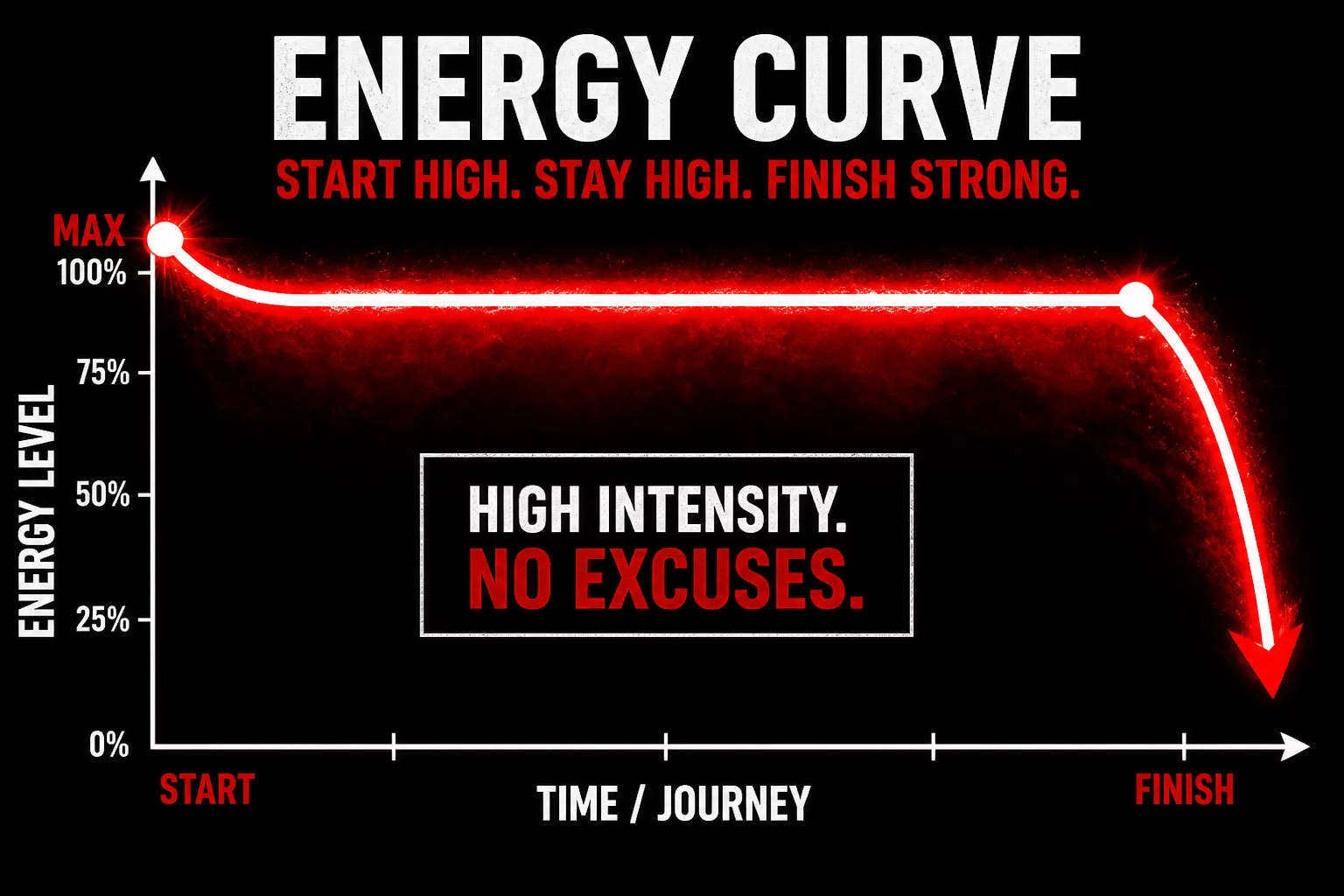
Traditional progression models lean heavily on subtle introductory pacing, gradually building density across several tracks. The High Impact Opening Arc inverts this formula deliberately. By introducing a premier peak-energy weapon within the initial ninety seconds, the DJ seizes room acoustic authority and sets an uncompromising standard for kinetic engagement.
Navigating this arc requires careful frequency management and micro-modulations in harmonic tension. Because raw momentum is deployed immediately, the subsequent selections must manipulate groove textures, percussive timbre, and mid-range density rather than relying solely on progressive BPM increases. This structure prevents floor exhaustion while maintaining continuous sonic presence.
"Launching at maximum output leaves zero room for tentative mixing; your initial phrase must land with surgical precision."
Phase Breakdown and Spectral Transitions
Key technical parameters governing each structural sector throughout the high-velocity performance trajectory.
| Parameter Phase | Energy Level | Transition Mode | Recommended Track Type |
|---|---|---|---|
| 01. Ignition Pulse | 95% Output | Hard Cut on Drop | Driving Bassline Lead |
| 02. Tension Lock | 90% Output | 32-Bar Extended Blend | Rolling Rhythmic Groove |
| 03. Harmonic Modulation | 88% Output | High-Pass Filter Swap | Syncopated Melodic Hook |
| 04. Sustained Plateau | 92% Output | Stem Crossover Blend | Heavy Peak Anthem |
Managing the ignition pulse requires meticulous gain staging. When entering after a lower-tempo support act or silence, ensure the primary kick transient cuts cleanly through the acoustic space without triggering master channel limiting or acoustic distortion.
Harmonic Trajectory and Energy Stabilization
Systematic tactical solutions for preserving listener stamina during persistent high-intensity output.
Dropping directly into a dense frequency range can overwhelm an unprimed sound system. Precise low-end management guarantees maximum punch without muddying the sub frequencies.
- Utilize a 4-bar atmospheric sweep or vocal cue before releasing full low-frequency pressure to calibrate ear sensitivity.
- Ensure the introductory key aligns with the room acoustic baseline or executes an abrupt +2 semitone energy shift.
When operating at 90%+ energy levels, brief 4-bar percussive resets prevent physical dancefloor fatigue without lowering perceptible velocity.
- Drop low frequencies out for 2 bars before a rhythm fill to deliver instantaneous tactile relief.
- Shift focus from heavy mid-synths to bright polyrhythmic shakers and hi-hat variations during intermediate track segments.
Maintaining momentum requires subtle key climbing rather than constant BPM acceleration, which risks exhausting the tempo envelope.
- Step upward through the Camelot wheel by +1 step every 3 tracks to induce progressive psychological lift.
- Anchor transitions with dominant root-note basslines to ground the harmonic momentum securely.
Alternative Energy Trajectories
Explore complementary arc structures to adapt your sonic pacing for different room environments and timetable allocations.
Set Arc Discussion
Observations, floor reactions, and acoustic calibration feedback from active DJs in the field.
No field observations recorded yet. Be the first architect to log performance telemetry.